The question which planet is closest to the Sun seems like a simple geography question. Yet there’s surprisingly more to it. Because while Mercury is the planet closest to the Sun, it’s NOT the hottest planet. Moreover, Mercury is difficult to see from Earth. In this blog, you’ll learn why this is and how you can still observe it.
Which Planet is Closest to the Sun?
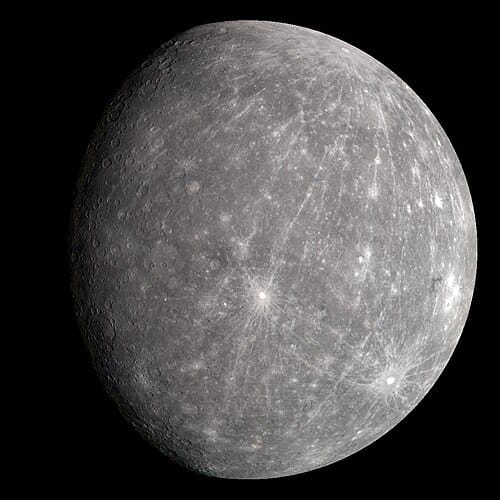
The planet closest to the Sun is Mercury. At a distance of just 58 million kilometers from the Sun, it’s the innermost planet of our solar system. Yet Mercury is far from being the most well-known planet — and there’s a reason for that. It’s small, difficult to spot, and often overlooked by beginners. In this blog, you’ll learn why Mercury is so special, how to find it, and why it’s NOT the hottest planet.
Mercury: the Innermost Planet
Mercury orbits the Sun in just 88 days and has barely any atmosphere. This causes extreme temperature fluctuations: from -180°C at night to +430°C during the day. Because there’s no atmospheric layer to retain heat, the night side cools down rapidly as soon as the Sun sets.
Why is Venus Hotter than Mercury?
You might think Mercury is the hottest planet — after all, it’s closest to the Sun. Yet that’s not correct. Venus is on average warmer than Mercury, with constant temperatures around 465°C. This is due to the powerful greenhouse effect of its dense carbon dioxide atmosphere. This effectively retains heat, both during day and night.
Mercury completely lacks such an atmosphere, causing heat to dissipate quickly. A fascinating contrast between distance and temperature.
Why Do You Rarely See Mercury?
Mercury is difficult to spot because it always appears close to the Sun in the sky. As a result, it’s only visible:
- Shortly after sunset (evening elongation)
- Or just before sunrise (morning elongation)
And even then, you have to look for it low on the horizon, with a completely clear view of the west or east. No trees, buildings, or fog — making it challenging for beginning stargazers.
Best Times to See Mercury
Two to three times per year, Mercury reaches its greatest angular distance from the Sun: the elongation. These are the best times to observe it. The exact dates change each year. You can find them in:
- Our monthly stargazing guide
- Online sky calendars like Heavens-Above or Stellarium
Tip: choose a clear evening or morning, and be on time — Mercury quickly disappears in the Sun’s glow.
How to View Mercury with a Telescope?
Mercury can be seen with the naked eye as a bright dot, but with a telescope you can see much more — especially if you know when to look.
Observation Tips:
- Use a telescope with at least 60x magnification
- Choose a good evening elongation
- Find a location with clear view of the western sky
- Use a moon filter to improve contrast
- Watch for Mercury’s phases (like the moon)
These phases occur because we view Mercury from a sharp angle as it orbits the Sun. It’s one of the few planets where this is visually well observable.
🔗 Also see our guide: Planet watching with a telescope
Mercury in the Sky: Fast and Changeable
Mercury moves on average one degree per day across the sky. This causes its position to change rapidly. Visible at sunset on Monday, by Friday it might have already disappeared.
This speed also explains its name: in Roman mythology, Mercury was the god of speed and communication — a fitting name for a planet that moves so quickly through the sky.
Did You Know this about Mercury?
- Mercury has no moons
- The surface is full of craters, chasms, and valleys
- The planet has the largest temperature differences of all eight
- It’s similar to the Moon, but has an iron core
- Mercury is the subject of space research (including ESA’s BepiColombo mission)
Conclusion: a Planet for Advanced Observers
Mercury is the planet closest to the Sun, but due to its position and weak visibility, it’s a challenging object. Still, it’s worth seeking out: once you spot it, it’s an impressive achievement.
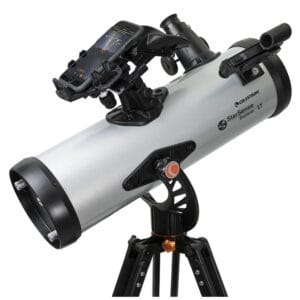
Want to observe Mercury yourself? Choose a telescope with good optics and sharpness at low magnifications. Even models like the Omegon 102/640 or the Celestron StarSense Explorer are suitable for this.